Reviewing the Seashell and Starfish Ocean Sticker
As a designer who spends more time staring at digitized paths than I do sleeping, I have learned that not every pretty picture translates well to thread. We often get swept up in the visual appeal of a digital embroidery file on a screen, forgetting the physical realities of needle penetration, fabric tension, and thread sheen. Today, I am taking a close look at the Seashell and Starfish Ocean Sticker, a graphic that promises coastal charm but requires a critical eye before it hits the hoop.
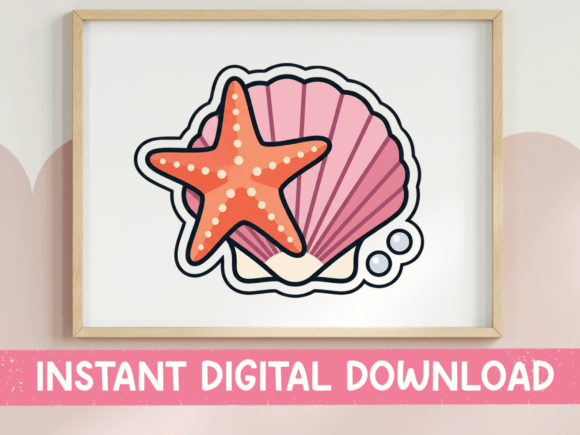
The first impression is undeniably cheerful. The composition features a large pink scallop shell with soft shading fanning out behind an orange starfish covered in pale ivory spots. It is a classic beach motif, but the execution matters. For those of us running a craft business or selling on Etsy, we know that customers buy with their eyes but judge with their hands. If the stitching looks messy or the colors muddy, the perceived value of your handmade product drops instantly. This design leans heavily on color contrast and shape recognition, which are both good starting points for a successful embroidery project.
Visual Impact and Design Layout
The layout of the Seashell and Starfish Ocean Sticker is compact yet distinct. The organic curves of the scallop shell provide a natural frame for the starfish, creating a cohesive unit rather than two disjointed elements. In terms of T-Shirt Designs and general Graphics, this works well because it does not rely on ultra-fine lines that might get lost in production. The "soft shading" mentioned in the description suggests the use of gradient fills or varied thread tones. From a technical standpoint, this is where you need to be careful. Shading in embroidery is achieved through layering fill stitch directions and changing thread colors. If the digitizer has not blended these transitions smoothly, you risk seeing harsh lines where one color stops and another begins.
The orange starfish with pale ivory spots adds a necessary pop of contrast. However, small details like spots can be tricky. If the spots are too small, they may require precise registration between the underlay and the top stitch. On a textured fabric, these tiny details could easily disappear. I recommend zooming in on your preview software to check the stitch count and density of these spots. If they look like solid blocks of color in the simulation, they will likely stitch out as dense, stiff patches that might pucker lightweight fabrics.
Real-World Application Scenarios
Let’s talk about where this design actually shines. I recently considered using a similar coastal motif for a custom tote bag design. Canvas tote bags are forgiving; they have a tight weave and can handle higher stitch density without warping. The Seashell and Starfish Ocean Sticker would look fantastic centered on a natural cotton tote, perhaps paired with a simple monogram below it. The pink and orange tones stand out beautifully against neutral backgrounds, making it an ideal choice for summer markets or beachside boutique merchandise.
Another strong candidate is sweatshirt embroidery. The thick, fuzzy texture of fleece or French terry cloth provides a plush background that makes the satin edges of the shell pop. Here, the design acts as a focal point on the chest or sleeve. Because sweatshirts are often dark or heathered, you must ensure your thread colors have enough brightness. A muted pink might vanish on a grey hoodie, so opt for vibrant rayon or polyester threads to maintain visibility. This transforms a basic garment into a personalized gift that feels high-end and thoughtful.
For baby embroidery, such as onesies or burp cloths, the softness of the theme is appealing. However, baby skin is sensitive, and baby clothes are washed frequently. You must ensure that the back of the stitching is clean. If the design uses heavy underlay or jump stitches that are not properly trimmed, they can irritate skin. Always use a soft, cut-away stabilizer for stretchy baby knits to prevent the design from distorting after multiple wash cycles.
Technical Considerations and Fabric Choices
While the design is versatile, it is not universal. I would hesitate to use this on very thin, slippery fabrics like silk or rayon challis unless you are an experienced embroiderer with the right stabilizers. The weight of the thread could cause the fabric to pucker around the shell’s edges. Similarly, avoid placing this on highly textured towels where the running stitch outlines might get swallowed by the loops of the terry cloth.
If you are planning to create an embroidered patch, this design is a strong contender. Patches allow you to control the backing and hoop tension completely. You can use a heavy tear-away stabilizer and dense stitching to create a rigid, professional-looking badge that can be ironed or sewn onto jackets and hats. Just remember that curved surfaces, like the front of a cap, require careful hooping. The width of the starfish and shell combination needs to fit within your cap frame without distorting the shape. Measure your maximum stitch width against your hoop size before committing.
Dark fabrics present another challenge. The pale ivory spots on the starfish need a solid foundation. If the digitizing does not include a proper underlay or a background fill, the dark fabric might show through the light thread, ruining the effect. Always run a test stitch-out on scrap fabric of the same color and type as your final product. This is non-negotiable for professional results.
Enhancing Product Value and Brand Consistency
For Etsy sellers and small shop owners, consistency is key. If your brand aesthetic is coastal, breezy, and handmade, the Seashell and Starfish Ocean Sticker fits perfectly. It communicates a specific mood instantly. When used in commercial embroidery projects, such as uniform polos for a beach resort or spa, it adds a touch of whimsy without being unprofessional. The clean lines and recognizable shapes ensure that the logo or graphic is readable from a distance, which is crucial for brand recognition.
To maximize engagement, consider how you present the finished product in your marketing. Use high-quality printable mockup images that show the texture of the thread. Customers want to see the sheen of the satin stitch and the dimension of the fill. Show the design on different items—a pillow cover, a kitchen towel, a tote—to help buyers visualize its versatility. This reduces hesitation and increases conversion rates.
Practical Designer Notes for Best Results
- Test on Scrap First: Never skip this step. Check for puckering, thread breaks, and color accuracy.
- Check Thread Contrast: Ensure the pink shell and orange starfish stand out against your chosen fabric. Use a color wheel if unsure.
- Review Stitch Density: High density can cause stiffness. Adjust if stitching on delicate fabrics.
- Confirm Hoop Size: Make sure the design fits your hoop with adequate margin for clamping.
- Inspect Small Details: Zoom in on the ivory spots. Are they too small to stitch cleanly? Simplify if necessary.
- Use Proper Stabilizer: Match the stabilizer to the fabric weight and stretch. Cut-away for knits, tear-away for wovens.
- Verify Licensing: Before selling items made with this machine embroidery design, confirm the license terms. Some files are for personal use only, while others allow commercial sales.
In conclusion, the Seashell and Starfish Ocean Sticker is a charming addition to any coastal-themed collection. It offers a balance of simplicity and detail that works well for various custom apparel and home decor items. However, its success depends entirely on your technical execution. By paying attention to fabric choice, stabilizer selection, and thread quality, you can transform this digital asset into a tangible, high-value product that customers will love. Whether you are creating holiday gifts, summer wear, or year-round boutique items, this design has the potential to perform well—if you respect the mechanics of the craft.